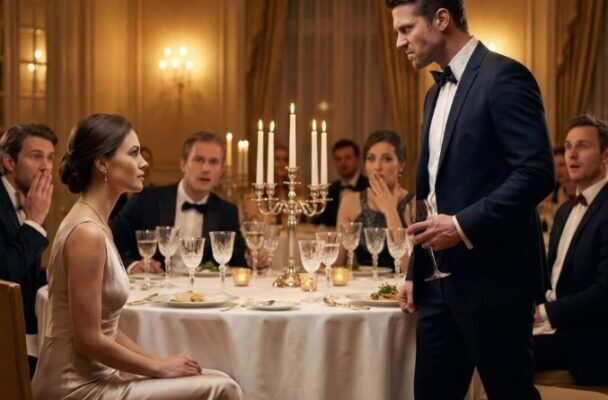
The dinner where it was never about the food
The restaurant was the kind of place that celebrated luxury as if it were a moral virtue—featuring heavy menus, soft lighting that made expensive faces look flattering, and a quiet assumption that anyone sitting at these tables must have earned the right to be there.
My husband Michael loved that feeling—not because he appreciated food in any deeper sense, but because he liked how a perfect space made him seem more important than he actually felt inside.

His mother Diane loved it even more, because she treated public places like stages on which status could be asserted, without ever admitting that this was exactly the goal.
From the moment we sat down, the evening was dictated by her choices, not mine, and its pace felt like a deliberate display.
Starters appeared that I had never ordered, arranged like trophies on plates, and when I opened my mouth to ask whether there might have been a misunderstanding, Michael smiled too quickly and said it was fine, because his mother deserved something special.
Then came a bottle—not just expensive, but theatrically expensive, the kind of bottle a waiter presents with particular reverence, as if the label alone should earn applause.
Diane leaned back and watched my reaction the way some people watch a slow film—waiting for the exact moment you realize you’ve been written into a scene you never agreed to.
“Open it,” Michael insisted when the waiter hesitated politely. “My mother deserves this.”
I remember thinking with a strange calm that the bill was already being composed like a weapon, because there is a certain kind of generosity that is not generosity at all, but pressure disguised as celebration.
It is not meant to bring joy; it is meant to create obligation, then shame, then obedience—and the pattern is always the same. First spend, then demand, and act offended when the target hesitates.
When the bill finally came, the waiter placed it neatly in front of Michael, because he was the one who spoke the most, who gave explanations, who acted like the host.
Michael didn’t even glance at it—and that detail meant more than any insult Diane could have uttered, because it showed how naturally he assumed what would come next.
He slid the bill across the table to me as if it were a harmless note.
“You’re paying,” he said with the casualness of someone asking for the salt.
For a moment I thought I must have misheard, because absurdity can sound like a joke when you are not prepared for it to be real.
“What did you just say?” I asked calmly, refusing to give them the satisfaction of my surprise.
Michael lifted his eyebrows impatiently, as if I were the one unnecessarily prolonging the evening.
“My mother brought us here, and we can’t look cheap. So pay,” he repeated, louder this time, as if volume could turn a demand into a reasonable request.
Across from me, Diane smiled—not warmly, but expectantly, as if she had finally reached her favorite moment of the performance. I looked at the total, and the number felt less like money than like a message, because it was never really about the price.
It was about placing me in a position where refusal would be treated as disrespect, and obedience as proof that I knew my place.
“I am not going to pay for things I did not choose,” I said slowly, letting each word land without aggression.
Michael looked at me as if he had never truly known his own wife, and Diane’s mouth twisted into something that looked like a private victory.
“I told you, darling,” Diane began in that syrupy tone people use when pretending to give advice instead of exercising control, speaking to her son.
Michael raised his hand to interrupt her, then turned back to me with a tight jaw, and I could see the moment his pride shifted into something colder.
The moment the room fell silent
What happened next was so sudden and so unnecessary that my mind tried, for an instant, to reject it as impossible—like a loud sound that appears without warning in a quiet room.
Michael lifted his wine glass and hurled it in a swift motion into my face—not clumsily, not accidentally, not uncertainly.
The liquid hit my cheek and jaw—first cold, then sticky—with a sharp smell that clung to my skin and my dress.
The restaurant did not erupt into chaos, because people in expensive spaces often freeze instead of intervening, but I felt every gaze shift toward our table in unison, like needles turning together.
My dress was stained, my hair at the temple damp, and the humiliation was deliberately staged in public, because private cruelty does not satisfy men who need witnesses.
Michael leaned forward, his voice so low it felt both intimate and threatening.
“You pay, or this ends immediately,” he said through his teeth, as if offering me a reasonable choice rather than presenting an extortionate ultimatum.
Diane’s eyes sparkled with satisfaction, and that was the most revealing part of the entire scene, because her pleasure confirmed that she wanted me to be pressured, not just billed.
It was not about etiquette or family pride; it was about obedience, and the bill was merely the pretext.
I slowly wiped my cheek, not because I was calm, but because I was holding back something far stronger than mere emotion. Anger can be chaotic when it is unstructured, but when it becomes ordered, it turns into action that does not ask for permission.
I looked Michael directly in the eyes and lowered my voice into a whisper that sounded like surrender.
“Fine,” I said, and I watched relief spread across his face, because he genuinely believed obedience was still the only possible outcome.
Then I reached into my handbag—not for a card, but for my phone.
The staff heard my words, not his version.
I raised my hand slightly to call the waiter, and when the young man cautiously approached, his eyes briefly flicking to the stain on my dress before quickly looking away again, I spoke with the controlled politeness that prevents you from being dismissed as hysterical.
“I need to speak to the manager, and I want the bill checked line by line, and I also need security,” I said, each request clear and specific.
Michael exhaled audibly, as if my refusal to stay silent had exposed him.
“Don’t be dramatic, Emily,” he snapped, using my name like a leash.
I didn’t respond to him, because any reaction would have put him back at the center, and I was tired of placing him there. Instead, I opened my banking app and held the screen so he could clearly see it.
“The card you want me to let you use is linked to our joint account, and that account is mostly funded by my income, and I am not going to pay to legitimize my own humiliation,” I said calmly enough that my voice didn’t shake.
Michael’s face went pale, and I recognized that look, because it was the look of someone realizing the other party has options.
“What are you even talking about?” he demanded, too loudly for the table.
“I am saying no, and I am saying your behavior has consequences,” I replied, still controlled, because control was the only thing that was entirely mine at that moment.
He leaned closer, his voice now smooth and hostile.
“No one will believe you because it will look like an accident,” he hissed.
I met his gaze without blinking.
“Accidents don’t come with threats,” I replied, letting the sentence stand in the room like a sealed declaration.
A few minutes later, the manager arrived with two security staff, and I felt an unexpected sense of relief—not because I needed saving, but because witnesses change the geometry of power.
The manager introduced himself as Mr. Reynolds, his tone professional, his eyes moving from my stained dress to Michael’s posture and then back to me.
“Ma’am, are you alright, and how can we help?” he asked.
“No, I am not alright, and I want the security footage preserved, and I want a written incident report,” I said, keeping my language factual.
Diane tried to shift into feigned outrage.
“This is outrageous, my son only—”
Mr. Reynolds interrupted her politely but firmly, the way people trained to prioritize the directly affected guest do.
“Ma’am, I need to hear the guest who requested assistance,” he said, and the brief shock on Diane’s face was almost comical.
I nodded and continued.
“I want the bill corrected, since items were charged that were never served to our table, and I want documentation because I intend to file a formal complaint about what just happened,” I said, avoiding emotional adjectives, because evidence does not need them.
One of the security staff stepped closer as Michael suddenly stood up, and that movement reminded him that the room no longer belonged to his narrative.
Mr. Reynolds returned with a detailed breakdown, and the facts were as unpleasant as I expected.
Two bottles had been charged that were never opened at our table, which meant the evening had been manipulated from the start—not merely poorly organized.
Michael’s voice softened, a new tactic—the one he used when control began to slip.
“Emily, let’s go, you’re making a scene,” he urged, trying to make my refusal sound like a mistake.
For the first time that evening, I smiled, and it was not warmth, not happiness, not forgiveness.
“The scene is you thinking you can treat me like this in public and still control how it ends,” I said clearly enough for the manager to hear.
Michael leaned in and whispered, attempting one last attack.
“If you call the authorities, you can forget this marriage,” he said, as if it were a punishment.
I looked at him calmly and replied in the same factual tone I had used all evening.
“That’s exactly what I want,” I said, turning slightly toward Mr. Reynolds. “Please call them, and please ensure the video footage is preserved.”
The report, the messages, the decisions
The officers arrived quickly, and I described what had happened without dramatizing it, because truth is strongest when stated plainly.
I described the bill, the pressure to pay, the liquid thrown in my face, and the exact words that followed: “You pay, or this ends immediately.”
Mr. Reynolds confirmed that the cameras had recorded the entire sequence, and I saw something collapse in Michael’s face—not because he felt remorse, but because he realized he could not rewrite the recording.
That night did not end with me crying in a sterile room while someone told me to calm down. I left with my documentation, my options, and my next steps already forming, because the moment had clarified something I had refused to name. That glass was not a one-time lapse; it was the culmination of ongoing contempt, control, and public humiliation disguised as family pride.
The next day, Michael sent messages that shifted between blame and pleading, between threats and remorse, and each message sounded like a different mask of the same person.
“You ruined me,” he wrote, later: “I didn’t mean it, I was provoked,” and later still: “My mother went too far, just come home, we can fix this.”
I replied only once—not with anger, but with clarity.
“You were not provoked into showing me who you are; you simply revealed it,” I wrote, blocked his number, and moved on.
I handled the changes to the joint account through legal counsel and proper documentation, because I refused to let chaos make me careless.
I am sharing this story now because I know how often women are pressured under the guise of unity, coerced in public, and afterwards lectured that it was for the good of the relationship, instructed to swallow humiliation as if enduring it were equivalent to love.
The truth does not always arrive with a cry, but it stands firm when it is held, documented, and defended without apology.