
My husband slapped my hand away in front of 120 guests and sneered, “Don’t embarrass me—you’re just a baby-making machine.”
For one brutal second, the room carried on as if nothing had happened, while my entire world fell apart behind my smile.
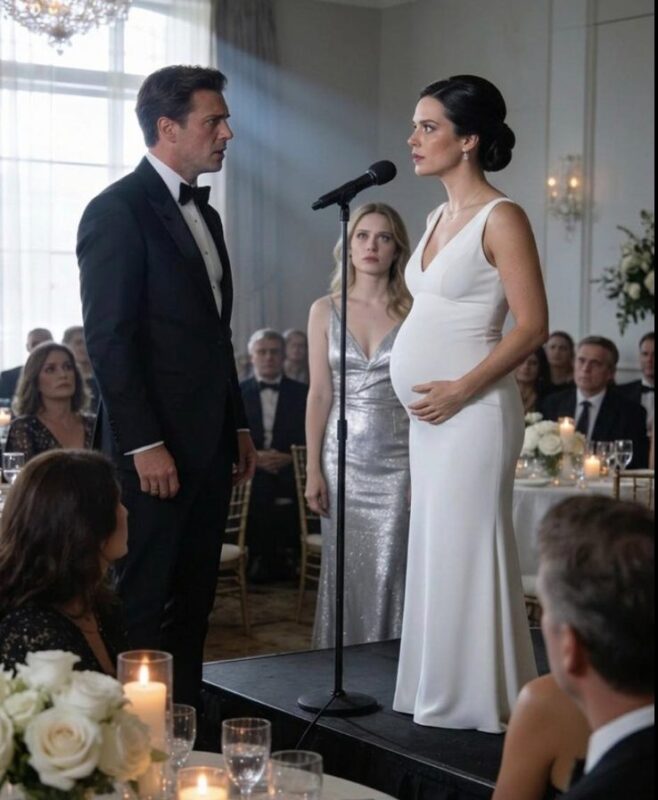
I kept my composure, took the microphone with trembling fingers, and decided that if he could publicly humiliate me, everyone in that room would immediately find out who he really was.
When the dessert was served, my feet were swollen, my back hurt, and every smile I wore felt borrowed.
The ballroom at the St. Regis in Dallas shimmered the way money always does—golden light, crystal glasses, white roses, and one hundred and twenty guests gathered to celebrate that my husband’s company had secured the city’s largest redevelopment contract.
Grant Holloway moved through the room as if he owned it—dark tuxedo, effortless smile, his hand on the small of my back placed just enough to look affectionate.
To any observer, we were the perfect American success story: a handsome developer, his pregnant wife, a baby due in nine weeks, a future that seemed secure.
Only I knew our marriage had died in February.
That was when I found the first hotel receipt in Grant’s glove compartment. Not because he was careless—but because he was arrogant.
Two nights at the Fairmont, champagne on the bill, late checkout, and a name I recognized immediately: Vanessa Cole, his head of public relations.
I would have left him over the affair—I should have.
But two weeks later, while looking for insurance documents, I found something worse in the office safe: loan paperwork tied to my late father’s company, Brooks Industrial—with my forged signature on three pages.
Grant hadn’t just betrayed me—he had used my inheritance to keep Holloway Development afloat while telling me business was thriving.
I didn’t scream. I didn’t confront him. I called Rachel Lin, my father’s most trusted attorney, and began gathering evidence. Emails. Transfers.
Condo payments hidden under a consulting account. Messages between Grant and Vanessa about “keeping everything together until the baby triggers the trust.”
That part almost made me laugh. Grant genuinely believed my pregnancy would unlock access to the Brooks family trust. He had spent months treating me like a walking vault.
So I let him keep believing it.
At our table that night, he barely acknowledged me unless someone important was watching.
When Councilman Avery congratulated us on “building a beautiful family,” Grant raised his glass and said, “Timing is everything.” Across the room, Vanessa—wearing a silver dress—smiled into her champagne glass.
Then Grant was called to the stage.
I caught his sleeve before he went up. Not to beg—just to see if he would still pretend in public.
He shook my hand off.
Not hard enough to bruise. Hard enough to echo.
Then he leaned down, smiled toward the room, and said, “Don’t blame me—you’re just a breeding machine.”
The conversations around us stopped instantly. Forks froze midair. Heads turned. One hundred and twenty guests watched my husband reduce me to a body in a dress.
I smiled.
Then I stood, walked to the stage before he could stop me, took the microphone from his hand, and looked every investor, board member, reporter, and donor in the room in the eye.
“Actually,” I said, calm as glass, “since Grant wants honesty tonight, let’s tell the full truth about what I’ve been carrying for him.”
You could feel the tension tighten around me.
Grant reached for the microphone, but I stepped back before he could grab it.
Pregnancy had slowed me down, not weakened me. “Sit down,” I said lightly, still smiling. “You had two years to talk. I only need five minutes.”
A nervous laugh flickered at the far end of the room and died just as quickly.
“My name is Amelia Brooks Holloway,” I said, “and the company you’re celebrating tonight did not save itself.
Holloway Development was kept alive with money siphoned from Brooks Industrial—the company my father built and left to me.”
Grant exhaled sharply. “Amelia, enough.”
“No,” I said. “Not even close.”
I turned toward the head table, where the board sat frozen beside untouched coffee cups. “Three months ago, I discovered my husband had forged my signature on loan documents and used my family’s assets as collateral without my consent.
I also discovered he used company funds to pay for a downtown condo, travel, meals, and gifts for his mistress, Vanessa Cole.”
Every head snapped toward Vanessa. Her face drained of color instantly.
Grant laughed too loudly, a brittle, forced sound. “She’s emotional. She’s pregnant and exhausted.”
“I am pregnant,” I said. “I am not confused. At 6:10 p.m.
tonight, every board member here received an email from my attorney—with copies of the forged documents, the transfers, the hidden expenses, and photos of Grant and Vanessa checking into the Fairmont on six separate weekends.”
Immediately, phones were pulled out at the main table.
The chairman, Walter Gaines, adjusted his glasses; his hands suddenly became restless as he unlocked his screen.
Grant stepped toward me. “You planned this?”
“Yes,” I said. “Just like you planned to take advantage of me.”
The room remained silent.
Then I gave them the part he had been counting on the most.
“For months, Grant has been telling lenders and investors that once our child is born, he will gain access to the Brooks family fortune through me. That is false.
He lost any claim to that estate the moment Rachel Lin filed amended protective measures with the probate court after we uncovered the fraud. He’s known this since yesterday morning. He simply assumed I wouldn’t say it out loud.”
Walter Gaines looked up. “Grant, tell me that isn’t true.”
Grant ignored him, his gaze remained cold and calculating, fixed on me. “You’re doing this out of jealousy,” he said. “You want to destroy my career before the baby comes.”
I almost felt sorry for him that he had chosen that argument.
“I’m doing this,” I said, “because last week I heard you tell Vanessa that, once the baby is born, you would make sure I was ‘medicated, controlled, and grateful.’
Your words. Not mine. And I heard Vanessa ask whether I would retain enough custody to still look respectable in photos.”
Vanessa shot up so abruptly her chair tipped backward. “Grant, do something.”
At that moment, the mood in the room shifted. Not when I exposed the affair. Not when I revealed the forgery. But when everyone realized that he wasn’t denying any of it.
Walter rose slowly. “Security.”
Two hotel security guards entered through the side doors.
Grant’s jaw tightened. “Amelia, think very carefully about what happens next.”
“I have,” I said.
Then I placed a hand on my stomach, lifted my chin, and said the part that was meant to be remembered.
“I am not a baby vessel. I am the majority owner of the assets you stole, the woman you lied to, and the last person in this room you should have tried to humiliate publicly.”
No one applauded.
It was worse than applause.
They just looked at him, as if he had already disappeared.
The first sound afterward wasn’t shouting—it was the soft hum of a hundred and twenty phones lighting up at the same time.
Grant scanned the room, as if he could still control the story through sheer posture. Walter Gaines didn’t give him that chance.
In a voice as flat as stone, he instructed Grant to surrender his room key, his company phone, and his ID before security escorted him out. Vanessa followed a few steps behind him, a strap on her heel broken, her face wet with tears she tried to hide.
Grant paused at the ballroom doors and looked back at me one more time. “You think this makes you strong?”
Rachel Lin stepped beside me before I could answer. “No,” she said. “It makes her precise.”
That line almost drew laughter from the nearest table. Grant left, accompanied by the sound of his reputation collapsing behind him.
The adrenaline carried me for seven minutes.
Then my knees started to shake.
Rachel took the microphone from my hand. My friend Naomi—who had flown in from Austin because she said I sounded “too calm to be safe”—led me to a chair in a private lounge behind the ballroom.
Someone handed me water. Someone else brought my handbag. I sat there, one hand on my stomach, feeling my daughter move as if she had also been waiting for the noise to finally stop.
“Are you okay?” Naomi asked.
“No,” I said honestly. “But I’ve stopped being afraid.”
And that was enough.
By Monday morning, Holloway Development had suspended Grant pending investigation. By Wednesday, the board removed him entirely. Prosecutors opened a case for fraud, forgery, and embezzlement of company funds.
Grant’s lawyers sent threats, then settlement offers, then messages asking to keep everything private “for the sake of the child.” Rachel responded to each one with precise, relentless clarity.
I filed for divorce before the week ended.
During mediation, Grant attempted one last performance—navy suit, wedding ring, the face of a man rehearsing sympathy. He said I had humiliated him. He said I had destroyed our family. He said a child needed both parents under one roof.
I looked at him across the polished table and recognized a man who had mistaken access for ownership.
“You destroyed this family,” I said. “I just refused to help you hide it.”
He lost the house, his board seat, and any access to my family trust. What he was left with was supervised visitation rights after our daughter was born—because the court prioritized stability over drama, and I prioritized my daughter’s well-being over revenge.
Her name is Eleanor James Brooks.
I gave her my father’s middle name and my family surname. When she was placed on my chest—red-faced, furious at the world—I laughed and cried at the same time. She was healthy. She was perfect. She was not leverage for anyone.
Six months later, I stood in another ballroom—this one smaller—at the launch dinner for the Brooks Foundation’s maternal health program. No crystal chandeliers.
No staged glamour. Just doctors, nurses, local donors, and women from shelters now receiving prenatal care because the program existed.
I held Eleanor on one hip and took the microphone with my free hand.
This time, no one tried to take it from me.
I thanked the room, spoke for three minutes, and stepped back into applause that felt warm instead of sharp.
Eleanor reached for my necklace and yawned against my shoulder. At the other end of the room, Naomi raised her glass. Rachel smiled from beside the stage.
For the first time in years, I wasn’t performing a life.
I was living it.
And as my daughter looked up at me with my father’s grey eyes, I kissed her forehead and moved forward—without looking back.